Thursday, August 25, 2011

Ayung River in Bali, Indonesia


From where I'm sitting (a lobby in a hotel in a small town in Sulawesi), I can count 14 geckos on the wall. Last night the check-in clerk tapped a wall map "your room is here" and two lizards skitted out from behind it.

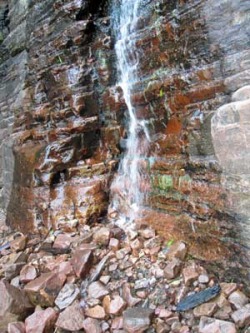
Last week was rafting on the Ayung River near Ubud in Bali. This small, free-flowing river passed through canyons and there were many waterfalls. At the end of the ride was a small side dam in part of the channel. Much of the landscape looks like this:


The green receptors in my eyes were completely saturated. 


Many of the photos from this post were taken from other webpages (sources 1 , 2 ,3 ,4 ,5 ,6 ,7 ,8 ,9 ,10 ,11 ,12) because I was concerned about getting the phone wet... but straight after the first bend was an unexpected delight. I caused a stir on the raft with all my "ooh! ooh!"-ing ("what is it? waterfall? monkey? snake?"). There was an automated river gage. It looks like a tall metal tube with a small shack on the top.

Even more unexpected was that there was another gage a few more minutes downstream, almost identical to the first, except that the bottom of the tube looked torn away. I've googled up one side of the internet and down the other and can't find any pictures of these gages. I tried to find info on Balinese streamgages, but the best I could find was that many years ago a few gages were installed but no readings were ever taken. I don't know if these are the same gages.

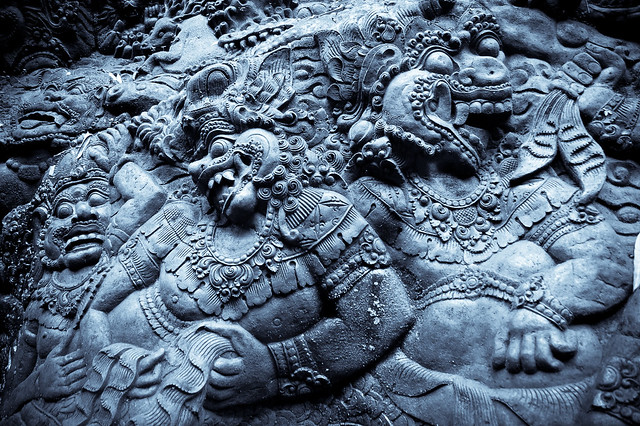
Speaking of surprises, nowhere was it advertised that there's a long stretch of the Ayung's banks that are carved by local artists, commissioned a couple years ago by a resort on the hill. Google turned up a photo of the artists in action:


The carvings are finished and here's a selection of some others' photos from the web


It goes on forever and has a baffling level of detail.

I did get a chance to stand under a waterfall:


If you feel that your job is difficult, consider the life of this lady, carrying dozens of wet life vests at a time on her head up hundreds of stairs.


Friday, August 19, 2011

Bali to the highlands

On the flight from Perth to Indonesia, we saw some great water features in Western Australia. There were many circular depressions filled with water, near the rivers. I had seen these on Google Earth before but didn't quite know what they were. I'm still not sure I know why they happen. 


Water quality seems a major concern in Indonesia and you'll likely see signs like this, even in relatively posh resorts.  

On our second day we went from Denpasar to Ubud to see a cremation ceremony for a member of the royal family. The driver was happily obliging although somewhat confused by my excited arm flapping and insistence to stop whenever we crossed over a bridge. Many of the rivers in the rural areas are in canyons and are pretty.  


It's the dry season right now so the water is low. 

 As we got closer to Ubud though, a few of the rivers on the outskirts had some trash but this was more the exception than the rule.

Wednesday, August 17, 2011

CSIRO floreat raingages

After talking with the folks at CSIRO Floreat (Perth), I took a stroll around campus. These are restricted sites, so I always recommend checking in with reception before visiting. These campuses though are usually a fascinating mix of green-spaces like the below...

next to rusty drums full of chemicals, windowless buildings labeled "Danger quarantine", experimental greenhouses and so on.


In a back lot I came across this little weather station. The wind direction vane looked like it had seen better days (the bent thing on the right) but the wind speed cups (the bowls on the left) where whirring away as the wind picked up. It then started spitting rain, coming down in horizontal sheets. I had to hide in a shelter for a dirt pile to keep dry. Soon after, the driveways started forming small streams.

On the other side of campus, my eyes just about fell out of my head when I came across this:


 I used to have something like this at my house in Portland. The inner ring fills up with rain pouring down the funnel. The black top comes off and the tube can be lifted out, read, emptied and put back in. If the rain gets very heavy, the water pours over into the outer ring. It was neat.


Sorry, I meant, "it was neat... times NINE!" There were nine gages at three different heights set up in a set of triangles.


In Portland I similarly had two gages next to eachother and would read both and compare them. It was surprising how different they could be, even just a couple feet apart. 

CSIRO floreat and Perths' water woes

Before leaving for Indonesia, I had a chance to spend at day at CSIRO in Perth/Floreat with Kevin Petrone and Richard Silberstein. They both work on a range of topics, but perhaps most in the news is their work related to this now famous chart of Perth water supply inflow. The data and chart are from the water suppliers and Kevin and Richard's group's work is in understanding what's going on. Each bar is a year's flow and the higher bars are the wetter years. The average flow for the last 5 years has been about 1/6th what it was from 1911-1974.

They believe that after dry years, the groundwater levels drop, making it harder to get good runoff later on, even if the rainfall comes up to normal. Indeed, the rainfall plot does not look nearly as bad as the runoff graph.

You might think of it this way. You have a bank account and there's income and expenses. When your balance gets low, the bank starts charging you fees. These fees keep knocking you below the minimum balance threshold. So you get more fees and keep falling behind. It's possible to break the cycle, but it takes a pay rise or maybe hitting the lottery.

Similarly, in a few years rainfall was low so the water table dropped. That makes it harder to get water from the landscape to the river. So then there's less runoff and the soils around the rivers dry out. Then the water table drops further and even if there's more rain, there's not as much of a connection between the landscape and the river.

Monday, August 15, 2011

Gage hunting in western australia

This week we were in Perth... Everyone recommends going to Kings Park, which has a sweeping cinematic view of the skyline and the Swan River. To my delight and surprise Kings Park is also home to the Mount Eliza reservoir, built in the 1890s. 

It's covered by a large shed and has two rings of chain link fences around it, but still, it was a good start to a great day. Must remember to call ahead next time to try and get the behind the scenes tour.

The next must-see place near Perth is Fremantle. It's where the Swan River meets the Indian Ocean. It has many historical buildings and is a major port. After a good amount of googling we were able to find the sea level sensor, as shown below.


I'm not completely familiar with sea level gages, but I'm pretty sure it's the red and white boxes. There's probably a float in the thin gray pipe that goes vertically into the ocean on the right (between the red and white box). Then there's the large gray box on the left that may or may not be related. 

Fremantle has a very long history of sea level measurements, available at the Bureau of Meteorology website. The 1890s are on the left and 2011 is on the right. There's a good amount of variability throughout the month (the difference between the red and blue lines) but also there's a relatively steady trend. Some 2-5 year wiggles along this trend are due, among other things to El Nino. As sea level goes, this isn't a lot of variability compared to other places. Broome, for example, varies about 9 meters/27 feet between the monthly maximum and minimum tides. 


Kitty and I had a delightfully romantic time snapping photos at the edge of the government compound with the gauge in the background. I think it's going to be a long year of peering through chain link fences.

Oh, but it doesn't stop there! On our way back to Perth we took a late night stroll down to Swan River at Barrack Street Jetty, the streamgage at the very foot of the Perth central business district. The silver box likely contains some electronics, the gray tube has a float in it that measures river level, the gray pole to the right on it had an antenna (not shown). According to this interesting article about how flooding works in Perth, the city was under 2 meters of water for weeks in 1862.


The yellow dumpster had trash from the nearby Annalakshmi restaurant, I believe?

Saturday, August 13, 2011

On the road: keys to the past

Today we took our first flight in this around-the-world year of travel. It's a dark and stormy night here in Perth, Australia.

We had a party with friends and spent our last night in Melbourne in a hotel. In the morning packing it all started to feel real when I had to toss the last of my keys in the trash.


This bin got a whole lot fuller by checkout time!


Friday, August 12, 2011

Market crash


 (sources herehere and here)


At the start of this week we had a farewell dinner with our house hosts Trudy and Ian. He is a financial adviser and we we were talking about communicating risk to his customers. I can see parallels between giving investment advice and being a forecaster. Good predictions of rivers can be like money in the bank to some users. But what happens when the market crashes?

At first I thought there must be that sinking feeling, an initial denial as to what's happening. There's that sense that there has to be an "undo" button, "please let this not be happening". Then there's the gut churning realization that the money is gone and not coming back. It seems unfair. I shouldn't be going through this.
Do we really deserve this?
 Ian may have seen it in a different way. Of course we deserve this. Everyone knew the risks, even the risk of extreme events. This should come as no surprise. Ian said he wasn't a financial adviser, he was a risk manager. What is the risk? What is your objective? How much risk are you willing to accept?
The stock market or river levels?
He said the worst part of his job is getting a call from his mother, asking how things are going (when everybody knows things aren't going well). My mother used to call me and ask if I was responsible for the flood in this region or that. Honestly, it wasn't my fault, this kind of thing just happens.

Saturday, August 6, 2011

Funny names for snow measurement sites

Western US river forecasters depend heavily on data coming from measurement sites in the mountains. SNOTEL is the main snow monitoring network run by the USDA Natural Resources Conservation Service, the same agency that also makes forecasts (along with the National Weather Service). 

Nearly every day I used this data, even if I only got to visit about two dozen sites. They're often named after some local feature, like a nearby mountain or lake. I always imagined that Magic Mountain in Idaho was covered in gumdrops or Thunderhead in Colorado was home to the Old Spice Guy. Some of the sites sounded like where you'd be assigned to do fieldwork if you made your boss angry. 

Saddle mountain, Oregon is in the middle of a clear-cut forest. Not the most pleasant place to be.

Here's my countdown of the most depressing sounding snow measurement sites in the Western US

10 Slumgullion, Colorado
9 Vacas Locas, New Mexico - translates to "Crazy cows" from Spanish. I have to think there's a good story there.
8 Toe Jam, Nevada
7 Hardscrabble, Utah
6 Sucker Creek, Wyoming
5 Rough and tumble, Colorado
4 Bloody dick, Montana - named for an englishman who lived there in the 1860s that cursed like a sailor
3 Dismal swamp, California
2 Disaster peak, Nevada
1 Calamity, Washington


Thursday, August 4, 2011

Black swans


Earlier this week I had a chance to catch up with Andy Wood (right) and Martyn Clark (middle) while they were in Melbourne for a CSIRO/Bureau of Meteorology science conference. Andy was a driving force behind an advanced streamflow forecasting system for the Western US and is now a hydrologist at the Colorado Basin River Forecast Center. Martyn is a research scientist and a developer of one of New Zealand's river forecast systems. Andy and Martyn had never seen a koala so we took a day trip down to Phillip Island. I warned them that the koala is Australia's most boring marsupial but we'd probably get more entertainment from the kangaroos.
Cute, yes
At the wildlife park we came across some black swans and their chicks. For a very long time people assumed that black swans didn't exist because historical records had only ever reported finding white swans. Much to everyone's surprise, black swans were eventually discovered by explorers in Western Australia (on the recently mentioned Swan river, funnily enough). 


Now, the phrase "black swan" (popularized by a recent book) has come to mean a surprise with a major impact that seems obvious in retrospect. For example, housing prices could never go down because they've always gone up. I suppose smoking is safe because I've never met someone who got cancer. It's safe to build by the river because no one has ever seen a flood that high (at least in our lifetimes). 

The discovery of a "black swan" is outside the realm of normal human experience, but once it happens, it's confronting. There's no more denying that is could happen, because it did happen. There's no un-ringing that bell.

In river forecasting, it sometimes seems like there's a limit to how wet things could get, the record highs cluster around a certain level. It can be like how new Olympic records can only shave a few tenths of a second off of previous times because things are already so fast. But when I started forecasting, southern Utah had a year that blew the doors off all the previous records... There was more snowpack than anyone could have imagined was possible. The question then was how much runoff there'd be? That's a story for another day, however.

In the end, we did get more fun out of the kangaroos. The park had bags of feed and the kangaroos would eat out of our hands. One mugged me and tore open the corner of my bag with his teeth. We thought this one had a face like one of Gary Larson's Far Side cartoons.


Thursday, July 28, 2011

Disappearing waterfall


Speaking of waterfalls, here's a picture of me at Silverband falls in the Grampians, mountains to the Northwest of Melbourne, Australia. The water falls disappear into a rock base. They reappear about 50 meters away, even when the flow is relatively high.   


Here's another angle from someone else's blog
(source)

Tuesday, July 26, 2011

Weird rivers: upward flowing waterfall

I'm always on the lookout for hydrologic oddities. Here's a great example from the BBC, with video

Waterfalls flow upwards in extreme wind

Winds battering southern Australia over the last 24 hours have been so strong that spray from waterfalls south of Sydney has billowed up into the air. Nearly a month's worth of rain has fallen on the city in 24 hours, and wind speeds have reached 120km/h (75mph). The extreme weather has meant a rough ride on the city's ferries, and a high surf warning has been issued with waves expected to reach 5m (16ft).


(source)

Monday, July 25, 2011

Watermark: The simulation builds its own momentum

We're rounding out our week over coverage of Exercise Watermark, the UK flood simulation. The occasion was the follow-up conference with participants. Already there's materials on the web about it, including slides from many of the key presentations. Kristy Chandler from Capita Symonds checked in and had this to say about the conference:

“About 250 people from various government departments attended to provide feedback on the exercise and the recently published interim report. The feedback received to date is positive - with people appreciating the opportunity to actively feed in to the evaluation process. And the feedback received will be very valuable in finalising the post-exercise report. Richard Benyon MP gave a very good presentation, as did Rod Stafford on behalf of the consultants. My company (Capita Symonds / VectorCommand) also sponsored a post-conference dinner which was a lot of fun, and included an awards ceremony. Awards were given to a number of individuals who performed well during the planning of the exercise or as players – all very well-deserved!”

We’ll finish off this week with one last question about Kristy's favorite moment during the Exercise Watermark.
In a flood command center (source)
Tom Pagano: What was the most exciting, or interesting, or insightful moment for you?

Kristy Chandler: We had certain people that were participating on different days. On the second day, the Cabinet Office Briefing Room (where all the ministers sit and talk to the prime minister) was so concerned about the news that there might be a coastal flood event happening, they started requesting all this information from other people. Those were experts that weren’t actually meant to be participating on that day, but the experts came in and started responding without their briefing, just purely in reaction to the requests from this cabinet office because they’re important.

The whole exercise became alive, even without us “stimulating” it by sending them “injects” [points when new pieces of information were revealed]. We thought, “Wow, this is amazing”. All you need to do is just stimulate a group – and this was a very large group of people – for it to become alive and gain its own momentum. I was impressed by that.

But it’s scary because you only need, with a big group of people, a couple of little things and the interaction between them all can turn it into something much bigger. It happens in life all the time. People end up doing something based on a couple little bits of information to start with and get spooked. But in this case it was positive and made the exercise exciting, very “real life”, and part of why everyone has said it’s such a success.

Sunday, July 24, 2011

Watermark: Practical advice for surviving a flood

Dealing with disasters can be a useful analogy for dealing with life. We try and prevent bad things, but some problems are inevitable. We need to know how to handle when problems do happen. Today we talk about risk management and Kristy has some good advice on what to do if a flood does hit.

(source)

Kristy Chandler: I think [risk management] is relevant to all aspects of our lives. The biggest lesson for individuals and communities is to make sure that they do their own risk assessment, and have their own plan in place. And that’s something that’s really being encouraged at the moment in the U.K. because there are just so many [people at risk].  There’s five million properties currently expected to be at risk of different types of flooding, and there’s no way that all of them can be defended and all floods prevented.  There’s a drive for individuals and communities to be aware if they are at risk and come up with their own flood plans.

It’s just being prepared, really. Aware and prepared- that can go to all kinds of aspects of life, doesn’t it? It can be having a fire alarm in your house in case of a fire or insurance if your house was to burn down.  Be aware of the risk and then do something to manage if it was to occur. We’re encouraging community members to have a little flood pack in their cupboard, and if they were to be flooded, they would grab the pack. It might have a blanket and first aid kit in it, and a can of beans, a map showing them where they’re supposed to go. For that kind of thing, we’re really good at fire but we’re just getting there on flooding.

Tom Pagano: That’s an interesting idea, that not all disasters are preventable. You could try to protect yourself but something is always going to slip through, no matter how hard you try.  You could live in a house with iron bars and bullet proof glass but it’s expensive. Besides, you’re not really living a comfortable life in a Kevlar house.

Maybe not the best place for entertaining guests (source)
Original caption: This reinforced concrete safe house is designed to allow someone to control the new hurricane protection gates at the mouth of the 17th Street Canal, even during a hurricane. If it looks like a storm is going to be strong enough to destroy the safe house, the people inside can escape out the back and then the gates can be remotely controlled. Read more


Kristy Chandler: It’s part of the risk-based approach. You can never completely eliminate flood risk because it can always rain more than you expect, and more than you design for.  So you design for something that’s appropriate to the level of consequences. In an area that’s, say, farmland, you may not defend it to a level that’s very high, but a hospital you may want to put extra measures in to make sure it doesn’t flood.

There’s always – even if you do put defenses in– the risk that those defenses will breach.  So, quite often, we’re putting emergency plans in place to respond to flooding if primary defenses fail. That’s another [issue] for flood risk management.

Tom Pagano:  I saw something about this for the Tsunami in Japan. They have natural flood barriers of trees on the shore. The barrier is good for breaking up a medium-sized tsunami. But for something that’s overwhelming, then those trees just become projectiles. Then you have trees rammed into buildings. I’ve seen some astonishing photos.

Japan tsunami damage (source)

Kristy Chandler: The legislation in the U.K. requires you to assess the risk behind defenses.  So even if there is a flood defense against a Tsunami, you need to assess the risk if that was to fail or over-top, and put measures in place to make sure that people would still be safe.

Tom Pagano: Do you have any practical advice for if you’re ever in a flood? Someone asked me the other day if I knew what to do if I had warning of a meter of water in my living room. I’m not sure I know the answer to that… and I’m a hydrologist!

Kristy Chandler: You don’t want ever want to walk through flood water.  One of the very dangerous things is that manhole covers lift, and if you’re swimming or walking through flood water, you can get sucked into the sewer… Obviously, that’s going to be the end for you because there’s no oxygen. [Walking through a flood is] the thing you just don’t want to do. 

If you’ve got a double story house, then you might want to go to the top floor. In Queensland recently they camped on the roof. You would probably want to evacuate the area if you don’t have a double story house, before the flood water hits. And if you can’t evacuate in time, go for the highest point and call someone, if you can.  Try and get some kind of a message to people to come and rescue you.

Not the kind of thing you want to see on the news (source).
Tom: I might add that you should be very cautious about driving through water. You’re never completely sure what’s under the surface and even 6 inches of water can cause problems. If you stall when the exhaust is under water, the car won’t restart until it is towed or pushed out of the water. In Arizona they had what was called the “stupid motorist law”. If you drive into water and get in trouble, you have to pay for the cost of being rescued. The irony, of course, is that whenever there’s a flood, the standard image on the evening news is of cars driving through water. For more driving advice during floods, go to http://www.smartdriving.co.uk/Driving/Driving_emergencies/Floods.htm

Thursday, July 21, 2011

Watermark: So “code white” doesn’t mean “smoke break”?

Today we’re discussing the essentials of good communication in a disaster situation. We’re also talking about having to make decisions based on limited information and in a hurry.

 (source)

Tom Pagano:              I imagine there was a lot of communication that you did with the emergency managers, and then they had to communicate a lot with each other. Do you have any ideas for what makes a good, clear, effective message when you’re communicating?

Kristy Chandler:           One of the really important things to do is to have a generic email address that’s not Joe.Blow@fire.com. It’s better to have emergency@fire.com so that it’s a dedicated emergency line that people communicate to in any kind of situation. It should be on a highly secure system that’s been assessed for all kinds of risk. You should make sure it’s capable of receiving attachments of different sizes and doesn’t screen out because it’s got a firewall that’s too high. 

                                    There needs to be a secondary system in place if that was to go down. There should be another way of doing that communication, and that that needs to not only be in your plan, but it’s communicated to all of the people that may wish to contact you.

Tom Pagano:              And then the actual message itself?

Kristy Chandler:           Well, it’s difficult because there’s codes that all emergency responders use. Sticking to the published/industry standard codes is useful because in different areas they will have their own codes that they like to use. If you stick to a published standard then that’s useful, and using as much plain language as possible.

The fifth keyboard is being used as a foot pedal (source
This is much like how they say “code blue” in hospitals as shorthand for when someone in cardiac arrest and is in need of care, urgently. Frustratingly, different hospitals have different codes. “Code black” means severe weather in Chicago, someone’s being attacked in Australia or there’s a bomb threat in Wyoming.  Imagine if you shouted “code white” and the local nurses clamored for the rubber hoses and the visiting nurses went for a smoke break. Clearly everyone wants to be using the same standard, but it can be tricky getting people to give up what they know to learn something new.

Tom Pagano:              Is there negotiation that goes on between [emergency mangers?] Is it just, “I’ve detected something.  I’d like to pass it on to the people that need to know”, or is it [more like “we should be putting more people down in district X”]?

Kristy Chandler:           Negotiation does happen in these cross-agency meetings. They do that face to face, and it really depends on peoples’ personalities…

Tom Pagano:              I wonder about how you keep personality out of this? Sure, there are good things about having intuition and charisma… but then there’s the other side of it.

Kristy Chandler:           [Laughing] I don’t think there’s any Hollywood movie that hasn’t had some charismatic, gutsy, yelling-at-his-boss hero in an emergency situation.

Tom Pagano:              “We need to get those helicopters in the air right now!”

Kristy Chandler:           Whether or not the gutsy rebel hero is the one that would actually be beneficial or whether that’s just a Hollywood myth is something that’s interesting to look into.

But one of the things that we’ve noticed in this exercise is that during normal operational work, the people in these roles and doing these jobs (the ministers and their support staff) can operate in a risk adverse way - to avoid a bad political situation.  

In emergency situations these people are expected to just switch and turn into Rambo and become people who can take risks. They have to make decisions with potentially limited information. And it’s a challenge. Some people just aren’t used to switching within the time scales that are required. The behavior and dynamics of these things is very, very interesting…

A flagrant violation of parlimentary procedure (source)
Tom Pagano:              Which would you say you were…[more of a planner or a doer]? Have you changed through going through these exercises?

Kristy Chandler:           I personally am a very detailed planner who is very willing to then change the plan. [Laughing] I like to know that I’ve thought about things and that I’m not doing anything too ridiculous. But I’m very adaptable and willing to change that plan if things aren’t going well. 

Thanks Kristy! Take a code white and we’ll see you again soon. 

Tuesday, July 19, 2011

Watermark: Behind the scenes of a mock disaster


I asked Kristy Chandler about her favorite waterway and she didn’t hesitate in saying the Swan River in Perth, Western Australia. She grew up there before moving to the UK in 2003. I can see the influence of both continents- She has a cultured confidence that seems typical of the English. She also has that cheerful warmth that comes from heavy doses of sunshine during certain formative stages of development.


The Swan River 

She’s now an environmental engineer for Capita Symonds. She deals with all aspects of flooding – hydrological assessment and hydraulic modeling and risk assessment, and the application of those technical things to different areas. More recently she’s been looking at emergency planning. She flew to Melbourne to give several presentations about her work and we talked in a meeting room overlooking the Yarra River and the Polly Woodside, an 1880s sailing ship. I asked if the Swan River was small enough to jump across and said it would be better to catch the ferry.

So, here’s the first part of our conversation where we talk about Exercise Watermark and what it was like to be a part of a country-wide disaster simulation.

Kristy Chandler


Tom Pagano:              There’s a project that you’re involved with that you gave a talk about at this conference…what was [Exercise Watermark]?

Kristy Chandler:           People will probably be familiar with fire drills; essentially it was a flood drill. We hosted a mock flood event so that people could test how they would react and respond to that flooding if it was a real flood. It went from the Cabinet Office Briefing Room (COBR) [top level organizational response and reaction] all the way through to where the public were involved….We hosted a four day very widespread severe flooding exercise…50 organizations participated, and 10,000 people were involved.

…It started with the summer 2007 flood events and a post flood review that recommended that one of these exercises were held.  The U.K.’s government department’s responsible for flooding (the Environment Agency), were in charge of running it, and they needed some help for such a large scale event.  They hired a group of us consultants to provide that specialist expertise plus the software that was required to run the exercise. We’d plan it and deliver it, and are now reviewing it.

Tom Pagano:              Ok.  You developed all kinds of scripts of what would happen at different times… Put us in the place of one of the [flood exercise] participants…

Kristy Chandler:           They would have received a briefing pack a few weeks before to say that something is going to happen on the day. It included some general principles about the conduct of play during the day.  But everything else was a secret. 

                                    What we tried to do was to make it as realistic as possible so that they could go to work in the morning, sit down at their desk, grab their cup of tea, and then it would just start as it would in a normal event. It’s called a “command post exercise”, meaning that participants sit at their normal desk and receive bits of information in the normal way that they would receive it. 

                                    They would get a phone call (if they normally would) or they would get an email, and we produced television scripts so that they could watch the news three times a day to see the events unfolding.  And then they would use all those little segments of information to piece together the actual situation and then react to that. That’s how they would do that in reality.

Emergency response command center (source)
Tom Pagano:              In every disaster movie you see a command center… How realistic is that, people with clipboards running around? What is a realistic scene at an emergency control center?

Kristy Chandler:           It depends on where they are. In the U.K. there’s command centers all over the place. When they’re responding or interacting with people on the ground, that’s when they’re running around with the clipboards. [Laughing]

When the situation gets a bit higher, it becomes a meeting room, probably like in the movies. There’s a meeting room with a big table and all the chiefs of different organizations are sitting around it, discussing what their next moves are and what they’re going to do. And so we gave them the information and a scenario that was severe enough to actually make those centers and those meetings start up.

Tom Pagano:              What would be a severe enough situation to activate [the command centers]?

Kristy Chandler:           The U.K. is probably quite similar to Australia. You need two regions being affected by an emergency.  We ended up having 14 regions that were affected at various times during the exercise. If two or more regions need help, it needs to be coordinated by a tier above that.  It can escalate up all the way to the prime minister.

Tom Pagano:              Did you get to meet “the big guy”?

Not "the big guy", but pretty close when it comes to flooding. (more)


Kristy Chandler:           [Laughing] No, but we had plenty of minister [politician] participation.  One of the good things was that they were very enthusiastic and had a lot of fun playing. They came out of the day saying really positive things about their experience and how they enjoyed participating. There was a bit of a buzz, actually… There’s a kind of adrenaline that you get in these emergency situations.  That was good to know that they felt involved and engaged enough that they got that kind of buzz – you know, electricity.

Tom Pagano:              For someone who’s never been in that situation, how would you describe that adrenaline, or that feeling, that buzz?... Is it the sense of not knowing? Or the confidence that you have when there’s something to do and you know how to do it? Did you have your own sense of anticipation organizing this and not knowing how it was going to turn out?

Kristy Chandler:           Yes, I was one of the staff members at exercise control.  There was one central command center where we issued all the bits of information from and monitored how things were going.  And if things weren’t going quite right, we did some on-the-spot additional bits of information to get it back on track.

…Essentially we set up our own command center. Every morning you got the ten minute warning and your stomach turned slightly. You take a deep breath and then get going and there’s people running around… We had quite a lot of planning and testing.  And on the big day, yeah, it was a bit nervous! [Laughing] Butterflies, that’s how I’d describe it.

Tom Pagano:              Yeah. “Uh oh, cappuccino machine is down, what do we do?” [Laughing]

Kristy Chandler:           More like what if “our whole IT system is down!” But thankfully due to all of our testing and planning that did not happen.

Thursday, July 14, 2011

Exercise watermark week

Flood drills in the UK (from RNLI
In March, about 10,000 people participated in a 4-day realtime flood simulation in the UK called Exercise Watermark. The Cabinet Office Briefing Room (something like the bunker in the basement of the White House) was activated, helicopters were flying, mock-fatalities were strewn about. It was the UK's biggest yet emergency response exercise. It was done on recommendation of the report that reviewed the UK's flood response during 2007. 

You can see the big board from here (source)
At last week's IUGG meeting I had a chance to catch up with Kristy Chandler from Capita Symonds’ Flood Risk and Water Environment team. Her company coordinated the exercise, helping to write the script, manage the simulation command center and so on. We talked about what it's like to be a fly on the wall during a flood response, how people cope with the pressure and what's the best way to survive a flood. 

Today is the first day of a followup conference in London to review how it all went. There's been a few interim reports released. Stay tuned, we'll be discussing the exercise and seeing how the conference is going!

Saturday, July 9, 2011

The Most Polluted River in the World

So... We have a first destination. Indonesia. World's fourth most populated country. Get some scuba diving under our belts and go see the most polluted river in the world, the Citarum, east of Jakarta.

At a recent conference someone said "If you're looking to go on hydrologic tourism, you shouldn't miss the most polluted river in the world." I thought, it may be dirty, but surely there's some dribble of uranium coming out of an abandoned mine that's worse. It can't be so bad that it would cause instant death to anyone coming near the banks? Did it catch on fire like some other rivers?

Cuyahoga River catching fire, 1952

Well, there have been some awful things done to rivers. The Citarum River was a floating mat of waste. You would guess there was water by the boats of people floating through it. Washing their children and restaurants' dishes in it, it provides 80% of the water for 14 million people.

Citarum River 

The government got a loan for $500 million in 2008 to fix the river up so it may be less of an issue now. 

It may or may not be the most polluted river now, but Indonesia is a hub of activity for hydrology in the Pacific, home of the World Meteorological Organization's regional office for Asia.